






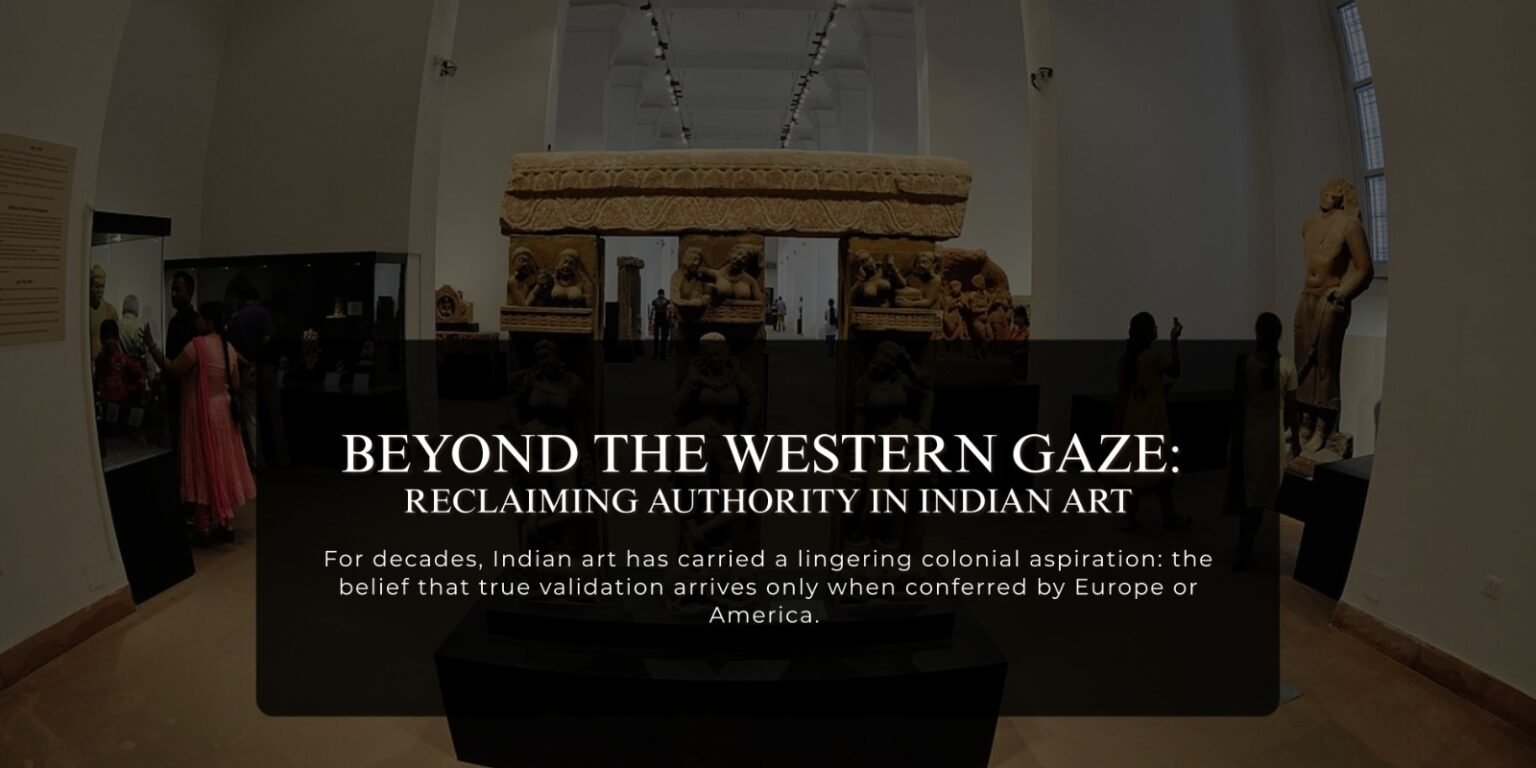

For decades, Indian art has carried a lingering colonial aspiration: the belief that true validation arrives only when conferred by Europe or America. Despite India’s rich artistic heritage and its rapidly expanding collector base, a significant portion of the country’s artists, galleries, and institutions continue to measure success primarily through Western approval. An exhibition held in London or New York is routinely regarded as more consequential than one held in Delhi, Mumbai, or Kolkata. Representation by a Western gallery, coverage in an international publication, or inclusion in a foreign collection is frequently treated as the definitive benchmark of artistic achievement, irrespective of the quality or depth of recognition already present within India itself.
The irony is considerable. India possesses one of the world’s oldest and most diverse artistic traditions, yet sections of its contemporary art ecosystem continue to seek external endorsement before acknowledging the merit already present within it. Colonial rule concluded politically decades ago, yet traces of its cultural hierarchy remain embedded within the structures through which Indian art is exhibited, evaluated, and collected.
This tendency is not without historical explanation. Much of how “fine art” came to be defined and categorised in India was shaped during the colonial period, as were the institutional hierarchies through which artistic merit came to be judged. The apparatus of exhibition, criticism, and canon formation was, for a considerable period, structured to channel prestige through European and, later, American institutions. Political independence altered the governance of the nation; it did not, on its own, dismantle the inherited hierarchy of cultural authority. That hierarchy persists today in more subtle form, embedded within professional norms that continue to privilege external endorsement over domestic judgement.
This tendency manifests consistently across the contemporary art ecosystem. Representation by a Western gallery is often treated as a more consequential milestone than sustained, considered support cultivated at home. Coverage in an international publication is frequently weighted more heavily than years of rigorous scholarship produced by Indian critics. Auction results and acquisitions abroad are regularly treated as more authoritative indicators of value than comparable outcomes within India’s own market.
None of this diminishes the legitimate value of international recognition. The concern arises when such recognition becomes a precondition for domestic respect, when an artist must first be acknowledged elsewhere before being regarded seriously within India.
When validation is habitually outsourced, so too is authority. Indian curators, scholars, and collectors are, at times, inclined to defer their own judgement until it has been externally corroborated, a pattern that unintentionally diminishes the standing of the institutions best positioned to evaluate this work with depth and context. Artists, in turn, may begin to shape their practice toward legibility for a foreign audience rather than toward depth and specificity within their own context.



For collectors, this deference carries a further consequence. The moment in which conviction, rather than consensus, ought to define the value of a collection is frequently deferred, and at times missed entirely, while external affirmation is awaited.
This is not an argument against international engagement. Global dialogue enriches artistic practice, and international audiences meaningfully extend the interpretation and reach of a body of work. The value of global exposure is not in dispute.
What must be avoided is the conversion of that exposure into a gatekeeping mechanism, the notion that an artist may only be considered significant domestically after having first secured recognition abroad. An artist should not become important within India only after being accepted elsewhere. The distinction between exposure and approval is the distinction that matters: one broadens the context in which work is understood; the other subordinates domestic judgement to an external authority.
There are measurable indications that this dynamic is beginning to shift. India’s collector base continues to grow, both in scale and in confidence. Independent platforms, art fairs, and biennales are establishing critical authority on their own terms, without reliance on external endorsement. A new generation of Indian scholars and critics is producing rigorous scholarship that does not depend on Western frameworks for its legitimacy.
This shift is visible in the choices made by collectors who acquire work on the strength of conviction rather than external endorsement, by artists who engage more deeply with specific, local concerns rather than moderating them for broader appeal, and in exhibitions that are recognised as significant on domestic terms alone.
The future of Indian art lies in confidence, not dependence. It requires the strengthening of Indian institutions, the encouragement of rigorous criticism, the cultivation of informed collectors, and the development of museums and galleries whose judgement carries genuine global weight. Each of these is a matter of sustained institutional investment rather than sentiment.
In practical terms, this requires serious critical writing surrounding the artists represented by Indian institutions, including catalogue essays and documented studio dialogue that provide substantive context for their work. It requires collectors equipped to exercise independent judgement, supported by rigorous context rather than external cues. It requires that an exhibition of merit held within India be accorded the same regard as one held anywhere else in the world.
The decolonisation of Indian art is not a rejection of the West. It is a rejection of the presumption that the West constitutes the final authority on Indian creativity. This distinction is a meaningful one, and it is the distinction on which the future credibility of Indian art institutions depends.
International recognition should follow domestic conviction, not precede it. When India begins to evaluate its artists on its own terms, international recognition does not cease to occur. It simply ceases to be the objective, and becomes instead a consequence of work that was already of consequence.