




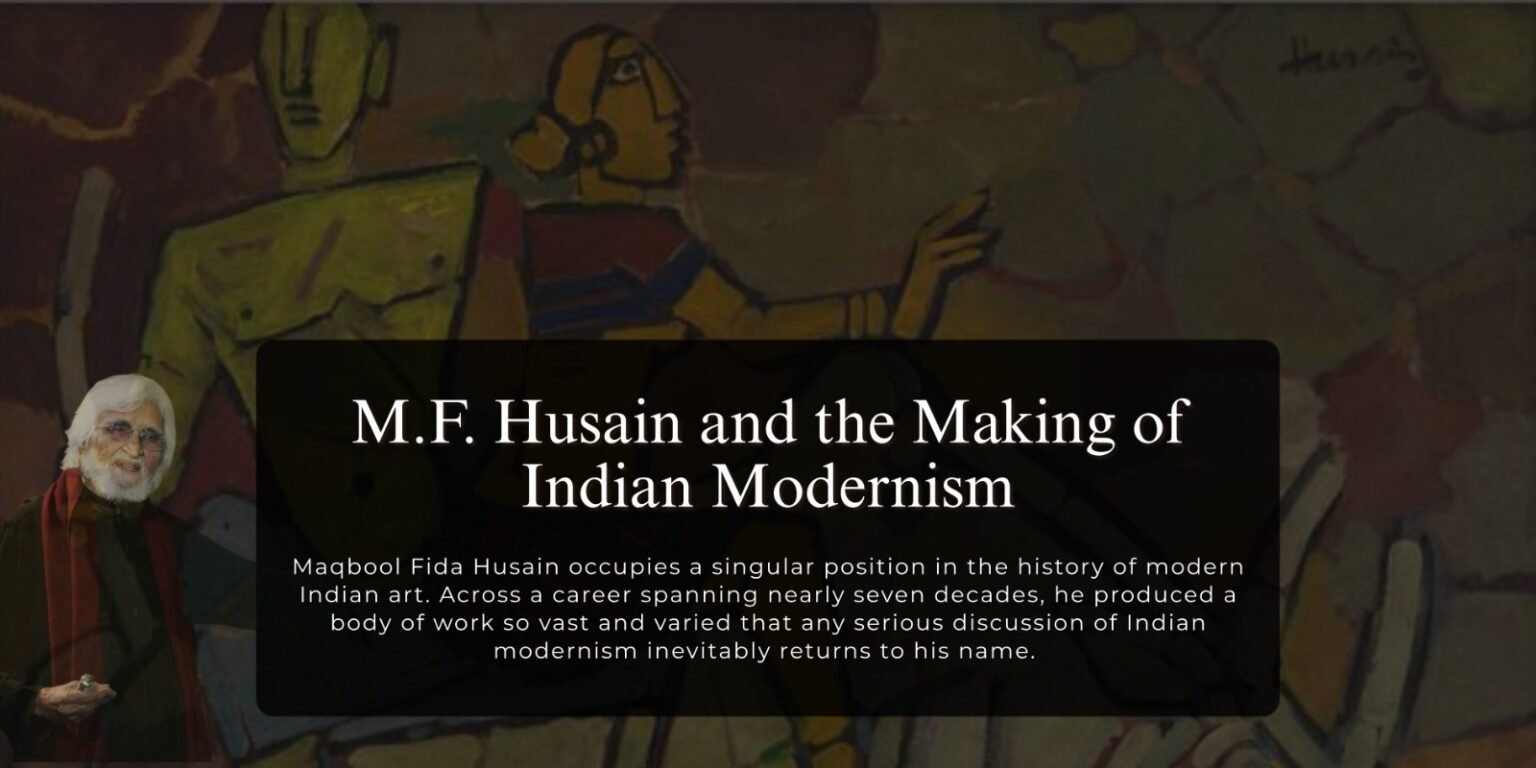

Maqbool Fida Husain occupies a singular position in the history of modern Indian art. Across a career spanning nearly seven decades, he produced a body of work so vast and varied that any serious discussion of Indian modernism inevitably returns to his name. For collectors, curators, and institutions engaging with twentieth century Indian art, Husain’s practice remains a critical reference point, one that continues to shape valuations, exhibitions, and scholarship today.
Husain was born on 17 September 1915 in Pandharpur, Maharashtra. He received no formal academic training as a painter, an unusual foundation for an artist who would go on to define an era. His early exposure to calligraphy at a madrasa in Baroda is widely regarded as formative, instilling the command of line and composition that would later distinguish his canvases. In 1937, Husain relocated to Bombay with minimal financial means, determined to establish himself as a painter. The years that followed were marked by commercial rather than critical work. He painted cinema hoardings for the Bollywood film industry and designed toys and furniture to sustain himself, an apprenticeship of necessity that nonetheless placed him at the intersection of popular visual culture and fine art. This early proximity to cinema proved lasting. Husain later moved into filmmaking, and his debut short film, “Through the Eyes of a Painter,” received the Golden Bear at the Berlin Film Festival in 1967, an achievement that remains notable within his broader body of work.
A defining moment in Husain’s career, and in the trajectory of Indian art more broadly, arrived in 1947. Alongside F.N. Souza, S.H. Raza, and other contemporaries, he co-founded the Progressive Artists’ Group in Bombay. Formed in the immediate aftermath of Partition, the group sought to move beyond the academic conventions inherited from the colonial period and to position Indian art within a more internationally engaged modernist framework. The formation of the Progressive Artists’ Group is now regarded as a pivotal juncture in the history of Indian modern art, and Husain’s role within it remains central to his critical standing.
Stylistically, Husain worked in a modified Cubist idiom, characterised by bold linework, vivid colour, and expressive form. His engagement with European modernism was evident, yet his visual language remained distinctly rooted in Indian sensibility. His work moved fluidly between register, at times playful, at times deeply serious, and was anchored by recurring motifs, most notably horses rendered in dynamic, energetic compositions, alongside elongated human figures captured in motion.
Thematically, Husain’s practice engaged with a broad and ambitious range of subject matter. He produced significant works depicting Gandhi and Mother Teresa, drew extensively from the Ramayana and the Mahabharata, and addressed both the British Raj and everyday Indian life. His horse paintings brought him considerable recognition and remain among his most sought after works. His eight part Indian Civilisation series stands as one of the most ambitious undertakings of his career, reflecting a sustained effort to chronicle the breadth of Indian history through paint. Voices, one of his notable works, was later auctioned for 2.5 million dollars, underscoring both his art historical significance and his standing within the international art market.
In his later years, Husain’s practice extended well beyond India’s borders. He spent considerable time in Doha and London, where he continued to produce large scale, ambitious work. Among his most significant late career commissions were extensive series addressing Arab and Indian civilisation. In 2010, he accepted Qatari citizenship, a decision that broadened his personal and professional identity while his artistic output remained closely tied to Indian subject matter and history.
Husain passed away in London on 9 June 2011. He left behind a body of work comprising close to 40,000 pieces, created across painting, film, and design over the course of seven decades. His contributions were formally recognised through India’s Padma Shri, Padma Bhushan, and Padma Vibhushan, three of the nation’s highest civilian honours.
More than a decade after his death, Husain’s influence on the discourse surrounding Indian modern art remains substantial. His capacity to move across mediums, subjects, and markets, from commercial cinema hoardings to major international auction houses, distinguishes him as one of the most significant and enduring figures in the history of modern Indian art. For those engaged in the study, acquisition, or presentation of Indian modernism, Husain’s body of work continues to reward close and sustained attention.