





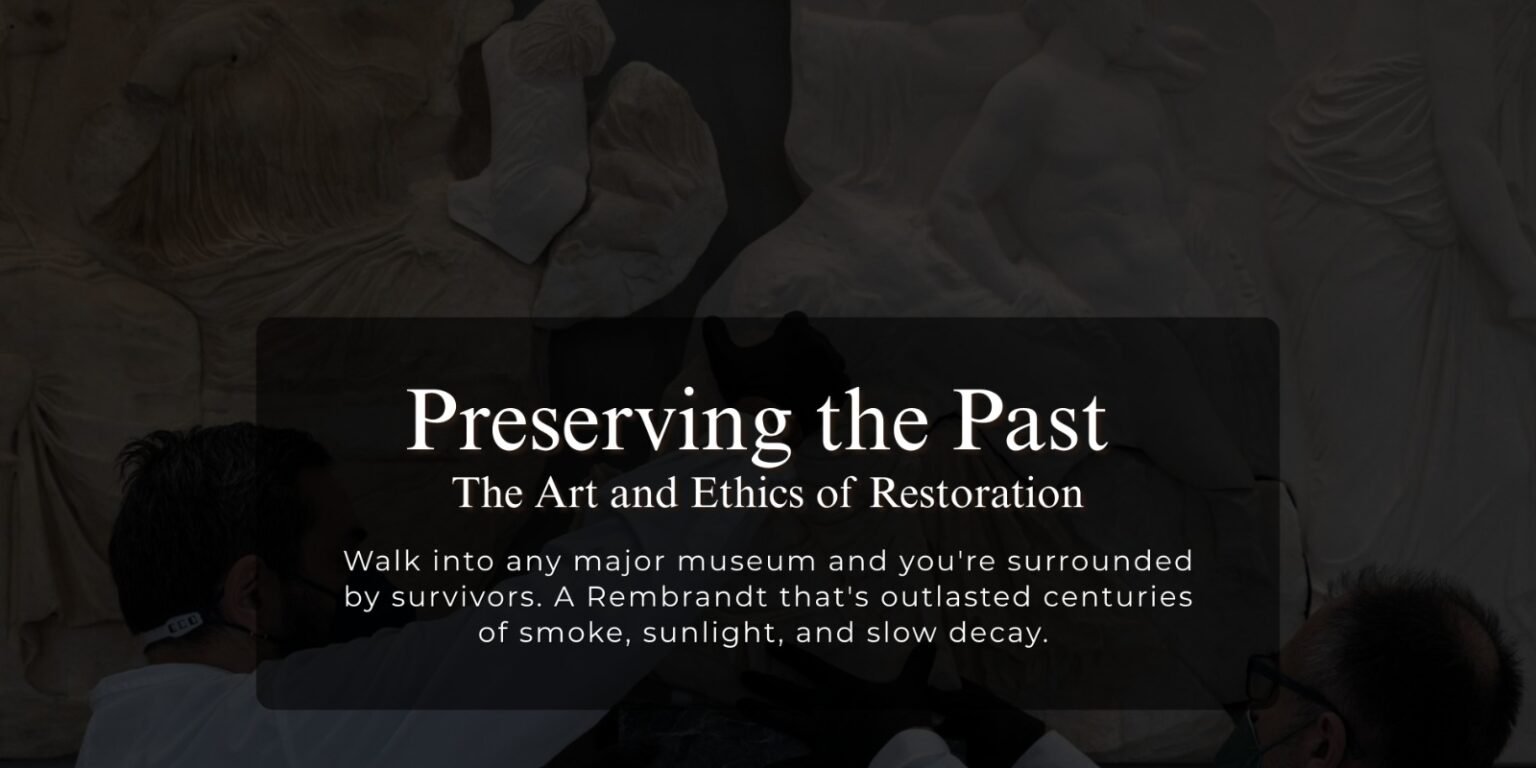

Walk into any major museum and you’re surrounded by survivors. A Rembrandt that’s outlasted centuries of smoke, sunlight, and slow decay. A marble statue that’s been dropped, buried, and dug back up, only to end up under gallery lighting a thousand years later. None of that happens by accident. Behind almost every artwork that’s made it this far is a quieter story: someone deciding how much of the past to save, how much to repair, and how much to just leave alone. Those decisions rarely make it onto the wall label next to the piece, but they shape everything about what you’re actually looking at.
That’s what art restoration is. It’s part art, part science, part ethics, and it takes real technical skill combined with genuine respect for a work’s history and what makes it authentic in the first place. A restorer has to understand pigments and chemistry well enough to know what a treatment will actually do to a surface, but they also have to understand the artwork’s story well enough to know what should never be touched at all. Get either half wrong, and the object pays the price.
People tend to use conservation and restoration like they mean the same thing, but they don’t. Conservation is about stabilizing a work and stopping it from decaying any further. It’s the quieter, more defensive side of the field, things like controlling humidity, keeping light exposure low, and preventing flaking paint from getting worse. Restoration goes further than that. It actively repairs damage and tries to bring a piece closer to how it originally looked, which might mean cleaning away decades of grime or filling in areas where paint has been lost entirely. Both fields come from the same ethical place, a deep respect for the object and its history, but restoration involves a lot more direct intervention on the artwork itself. That’s a heavier responsibility, and it comes with more room for things to go wrong, because every choice a restorer makes becomes a permanent part of the object’s history too.
The usual methods include cleaning, consolidation, inpainting, structural repair, and varnishing, and each one carries its own risks. Cleaning removes old varnish and dirt but can also strip away original glazes if it goes too far. Consolidation stabilizes flaking or lifting paint before it’s lost. Inpainting fills losses so the eye isn’t distracted by gaps, and structural repair addresses physical damage like tears, warping, or cracks in a panel. Varnishing protects the surface once the other work is done. Conservators tend to favor materials that are reversible across all of these steps, so if a future expert comes along with better methods or better science, they can undo the earlier work without damaging what’s underneath. There’s a kind of humility built into that approach, an acknowledgment that today’s best practice might not hold up once the field learns more, and that no restorer should assume their solution is the final word.
Once original material is removed, it’s gone for good, and that’s what makes precision so important here. This isn’t a field where you can experiment freely and course correct later. Paintings hold historical evidence in their layers, things like pentimenti, which are the artist’s own changes hidden beneath later paint, and period-specific materials that can tell historians exactly when and how a piece was made. Use the wrong chemical treatment and you can strip away original paint entirely, along with everything it could have told a conservator or historian down the line. That’s not just a loss of image, it’s a loss of information that can never be recovered through any other means. Precision protects both authenticity and long term value, and there’s not much room for error when every action is essentially irreversible on the physical object, whatever the intentions behind it.
Whether a piece still counts as “original” comes down to method, not how much of it was changed. That distinction matters a lot in practice. Work that’s evidence based, reversible, and distinguishable from the original keeps a piece’s authenticity intact, even if a significant portion of the surface has been treated. Replacing material that’s genuinely lost, say, a chunk of a sculpture that’s been missing for centuries, is generally seen as acceptable, since there’s nothing original left to damage in that spot. Painting over original work that’s still there, though, even if it’s discolored or not to someone’s taste, isn’t restoration anymore. That’s recreation, and it erases the artist’s actual hand in favor of someone else’s judgment. There’s no fixed percentage that draws the line between the two. It really comes down to professional judgment, transparency about what was done, and honesty with anyone who later examines the piece.
Four principles guide the work, and together they form the ethical backbone of the entire field. Reversibility means changes can be undone later, so a treatment applied today doesn’t permanently box in the conservators of tomorrow. Distinguishability means additions stay identifiable under close examination, even if they’re invisible to a casual viewer, so nobody mistakes a modern repair for the artist’s original hand. Minimal intervention means doing only what’s needed and nothing more, resisting the temptation to “improve” a piece beyond what its condition actually requires. And full documentation at every stage means the whole process, materials used, decisions made, and reasoning behind them, is on record for anyone who needs to understand it later. Together, these principles protect an artwork’s integrity and let future conservators revisit today’s decisions with full information, rather than having to guess at what was done and why.
Restoration depends on more than how a piece looks when it’s finished. Environmental control, material compatibility, and structural stability all matter just as much as the visible surface, since a beautifully restored painting kept in the wrong humidity can start deteriorating again within years. Ownership disputes and cultural sensitivity add another layer of complexity, especially with sacred or Indigenous objects, where the wrong intervention, or even the decision to restore something at all, can do real harm to a community’s relationship with its own heritage. Long term monitoring and limited funding shape outcomes too, since even the best treatment plan can stall or get scaled back when resources run short. Restoration isn’t a one time fix. It’s an ongoing responsibility that continues long after the visible work is done.



At its core, restoration protects cultural memory and artistic legacy for the future. It takes real technical skill paired with ethical restraint, and neither one is enough on its own. Interventions should honor the past instead of rewriting it, treating every artwork as a historical document as much as a visual one. Good restoration favors honest preservation over reinvention, so a work’s original identity can stay alive as it survives into the future, recognizable not as someone’s improved version of the artist’s work, but as the artist’s work itself, carried forward with care.